Jazz à Juan
What Is Jazz à Juan?
Jazz à Juan — formally the Festival International Jazz à Juan — is one of the oldest outdoor jazz festivals in Europe. It was founded in July 1960 in Juan-les-Pins, the seaside quarter of Antibes, by Jacques Souplet and Jacques Hebey with the backing of the local municipality. Their aim was direct: to bring the world’s great jazz musicians to a French Riviera audience at a time when most Europeans could only encounter them through recordings or in small clubs.
The festival made its ambitions plain from the very first editions. Within a few years it had presented Charlie Mingus, Ray Charles, Count Basie, Dizzy Gillespie, Ella Fitzgerald, Duke Ellington, Miles Davis, John Coltrane, and Sarah Vaughan — a roll call that read less like a regional festival programme and more like a draft of jazz history. Artists including Keith Jarrett, Herbie Hancock, Dee Dee Bridgewater, Nina Simone, and Oscar Peterson returned repeatedly over the decades, drawn by the venue and the atmosphere as much as any fee.
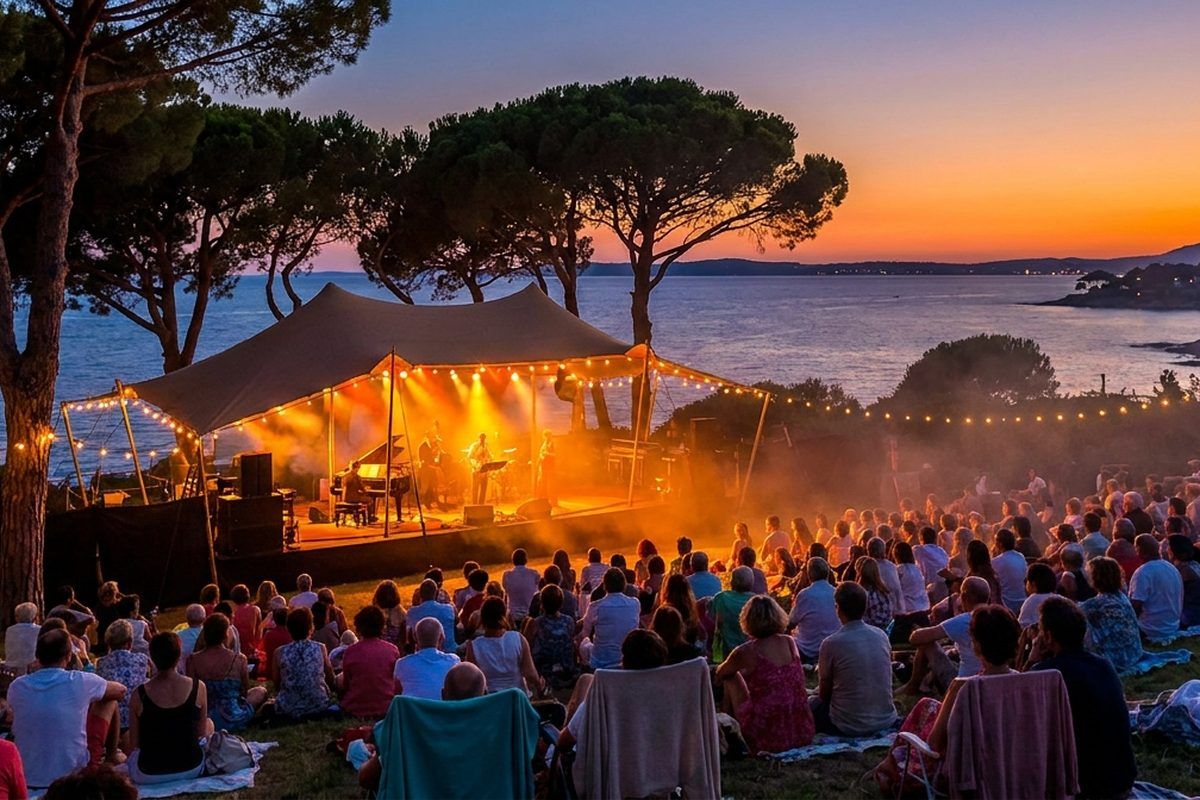
That venue — the Pinède Gould, an open-air stage set among century-old maritime pines beside the sea — is central to what the festival is and has always been. The setting gives the concerts a quality that purpose-built arenas rarely manage: intimate enough to feel direct, with the scent of pine and the presence of the Mediterranean making the whole thing feel like something other than a normal summer gig.
Over six decades the festival has broadened its programming to reflect jazz’s own evolution, embracing soul, gospel, world music, and electronic sounds alongside the more traditional strands. Its character, though, has remained consistent — a commitment to presenting exceptional musicians in an exceptional setting, with space for emerging artists alongside established names.
More than 30,000 spectators attend each year across the festival’s ten evenings.
When Does Jazz à Juan Take Place?
Jazz à Juan runs each July, typically across ten consecutive evenings. Concerts begin at 8:30 PM, using the length of the Riviera summer day to build atmosphere in the pine grove before the first act takes the stage.
Alongside the ticketed evening programme, the festival runs Jammin’Summer — a free open-air concert series on the Juan-les-Pins promenade that operates concurrently. Acts vary in ambition and style; the free stage is a genuine complement to the main programme rather than a warm-up.
Confirmed dates and the full programme for each edition are published on the official website at jazzajuan.com, typically from late winter or early spring. Tickets go on sale at the same time. If you are planning to attend, it is worth setting a reminder for the programme announcement date — popular concerts sell out quickly.
Where Does Jazz à Juan Take Place?
The festival’s home is La Pinède Gould on the Boulevard Edouard Baudoin in Juan-les-Pins. The venue is unusual: a grove of century-old maritime pines forms a natural canopy over the audience, filtering the evening light and shaping the acoustics in ways that an open arena cannot replicate. On clear nights the Mediterranean is audible and, from certain seats, visible beyond the stage.
Juan-les-Pins is a seaside district of Antibes, situated on the southern shore of the Golfe Juan. It sits between the old walled town of Antibes to the east and the open sea to the south, with a long promenade of cafés, restaurants, and a sandy beach. The two areas — Juan-les-Pins and Antibes — form a single municipality; Juan-les-Pins is the resort end.
Along the Boulevard Edouard Baudoin, embedded in the pavement, are ceramic handprint tiles created by more than 50 musicians who have performed at the festival over the decades. Walking the boulevard before the gates open is a good way to take the measure of the festival’s history. The tiles run from the earliest legends to more recent participants, and the boulevard itself is the promenade spine of Juan-les-Pins.
How to Get There
The simplest route from Nice is by TER train from Nice-Ville station to Juan-les-Pins. Direct services run throughout the day and evening; the journey takes approximately 25 to 30 minutes, and fares are modest. Juan-les-Pins station sits a short, flat walk from the Pinède Gould — around five to ten minutes on foot, signposted along the promenade.
From Cannes, Juan-les-Pins is even closer — around ten minutes by TER from Cannes station. Both routes run on the Marseille–Vintimille coastal line, which follows the Riviera shoreline and has departures well into the evening, with late services back to Nice and Cannes after concerts end.
Driving to Juan-les-Pins in July is possible but not recommended. The town is at its most congested during the festival period, parking near the venue is scarce, and the streets around the Pinède fill up long before the evening begins. The train removes these problems entirely and leaves you free to return at your own pace.
What to See and Do
The concerts are the reason to be here, and the Pinède stage has a record that speaks for itself. Recordings from the early decades of the festival are still in circulation — Miles Davis at Juan-les-Pins, Ella Fitzgerald and Duke Ellington together in 1966 — and the venue’s history is present in the setting. Coming to the Pinède for an evening concert means standing in the same spot where that music was made.
Arrive before the headline acts for the full experience. From around 7 PM, the venue area comes to life with food trucks, bars, and the audience settling in among the pines. The atmosphere before the music starts is part of what makes the festival distinctive.
The Jammin’Summer free stage runs throughout the festival on the Juan-les-Pins promenade, typically starting before the main-stage doors open. It is worth checking the concurrent programme — the free stage has featured strong acts, and it gives the festival a genuine outdoor breadth that extends well beyond the ticketed site.
Beyond the concerts: the Juan-les-Pins beach is one of the broader, sandier beaches on the eastern Riviera — good for a morning before an evening concert. Antibes old town, ten minutes on foot, has a covered market, the Picasso Museum in the Château Grimaldi, and a fishing harbour with genuine working character.
Where to Stay for Jazz à Juan
Antibes and Juan-les-Pins fill quickly in July. If you are planning around the festival, booking as soon as dates are confirmed is advisable. The promenade hotels in Juan-les-Pins itself put you closest to the venue; Antibes old town offers more character at a slightly slower pace.
Nice works well as a base if accommodation locally is beyond your budget or fully booked. The train connection to Juan-les-Pins is reliable and frequent, and the return journey after a concert is straightforward — late services run back to Nice-Ville from Juan-les-Pins station.
Practical Tips
Book tickets early. Main-stage concerts sell out, often well before the festival opens. Tickets typically go on sale in spring through the official website and through the Antibes Tourist Office at antibesjuanlespins.com. Popular evenings — opening night, weekends, any night with a widely known headliner — go first. Prices generally range from around €35 for standard seats to higher rates for premium positions.
Timing. Concerts begin punctually at 8:30 PM. Arriving 30 to 45 minutes early allows you to find your seat, visit the food stalls, and settle into the setting before the music starts. The hour before the music begins is among the more pleasant parts of a Jazz à Juan evening.
Late trains. TER services from Juan-les-Pins to Nice and Cannes run well into the night. Check the last departure for your evening before you travel, and note that services are busier than usual during the festival period — platforms fill quickly after concerts end.
Light layers. July evenings on the Riviera are warm, but two or three hours sitting still in the pine grove with a sea breeze coming in from the south can be cooler than you expect. A light jacket is worth bringing.
Free Jammin’Summer. If budget is a consideration, the promenade concerts are genuinely worth attending in their own right, not just as a consolation. Check the programme online for the schedule of acts and stages.
Frequently Asked Questions
- When does Jazz à Juan take place?
- Jazz à Juan runs each July, typically across ten evenings. Concerts begin at 8:30 PM. Check jazzajuan.com for confirmed dates for the current edition, which are usually announced in spring.
- Do I need to buy tickets in advance for Jazz à Juan?
- Yes. Main-stage concerts sell out, sometimes well before the festival opens. Tickets go on sale in spring through the official website at jazzajuan.com and through the Antibes Tourist Office. Booking early is strongly advised, particularly for weekend evenings.
- Is there a free way to experience Jazz à Juan?
- Yes. The Jammin'Summer free concert series runs alongside Jazz à Juan on the Juan-les-Pins promenade throughout the festival period. Acts vary; no ticket or reservation is required.
- How do I get from Nice to Jazz à Juan?
- Take a direct TER train from Nice-Ville to Juan-les-Pins — around 25 to 30 minutes, with frequent departures throughout the day and evening. Juan-les-Pins station is a short, flat walk from the Pinède Gould venue.
- What kind of music is performed at Jazz à Juan?
- The festival is rooted in jazz but programmes broadly, with traditional, bebop, and post-bop strands alongside soul, gospel, world music, and contemporary sounds. Emerging artists appear alongside established international names each year.