Nice Travel Guide: What to See, Do, and Experience
Nice, capitale de la Côte d'Azur

Why Visit Nice?
Nice is the French Riviera’s largest city and the natural base for the region. It sits at the eastern end of the Baie des Anges, with the Maritime Alps rising behind the city and the Mediterranean in front — a combination that gives it a character the smaller Riviera towns can’t quite replicate: real neighbourhoods, a genuine market culture, and a beach stretching the full length of town.
Vieux Nice, the old town, is the heart of it — a compact grid of narrow baroque streets painted in ochres and terracottas. The Cours Saleya, a broad market square a short walk from the sea, fills with flowers and produce every morning (antiques on Mondays). This is the part of the city people come back for.
As a practical base, Nice makes sense. TER coastal trains to Monaco, Antibes, Cannes, and Menton run frequently — most of what visitors want to reach on the Riviera is under 40 minutes away by rail.
When to Visit Nice
Summer (July–August) is warm and busy. The Promenade des Anglais fills with visitors, the beaches are at their liveliest, and accommodation prices peak. If you can go in summer, it works — just book well ahead.
February is one of the better times to visit. The Carnaval de Nice runs for around two weeks, bringing parades, floats, and a night programme to the Promenade and Place Masséna. The city is far quieter than in summer, the weather is mild, and the local energy that peak season can dilute remains intact. Accommodation still fills quickly during Carnival itself — book early.
Spring (April–June) and early autumn (September–October) offer a strong balance: pleasant weather, thinner crowds, and more accessible prices. The sea is warm enough to swim from around May through October.
Winter is mild by northern European standards. Most of the city stays open, the Promenade is still worth walking, and the Matisse and Chagall museums are unhurried. Beach culture largely disappears, and some smaller businesses keep reduced hours.
Getting to Nice
By air: Nice Côte d’Azur Airport (NCE) is one of the busiest airports in France and is well served from major European cities. Tram line 2 connects the airport to the city centre in around 30 minutes, running every 7–8 minutes and stopping at Nice-Ville railway station. Tickets are bought at machines on the platform and cost a few euros.
By train: Nice-Ville is the city’s main terminal. TGV trains arrive from Paris in roughly 5.5 hours; TER regional services run along the coast in both directions. From Italy, services connect through Ventimiglia. The station is a 15–20-minute walk or one tram stop from Vieux Nice.
Along the coast: The TER coastal train is the standard way to move along the Riviera from Nice. Services run roughly every 15–30 minutes throughout the day. Approximate journey times: Antibes 20 minutes, Monaco 25 minutes, Cannes 35 minutes, Menton 35 minutes. Fares are low — a single to Monaco is typically around €5.
What to See in Nice
Vieux Nice and the Cours Saleya The old town is the obvious starting point. Wander the narrow streets, find Place Rossetti and the Cathédrale Sainte-Réparate, then work your way along Rue Droite — the Palais Lascaris is here, a 17th-century Genoese baroque mansion housing a museum with an unusual collection of historical musical instruments. Arrive at the Cours Saleya before noon to catch the market at its busiest.
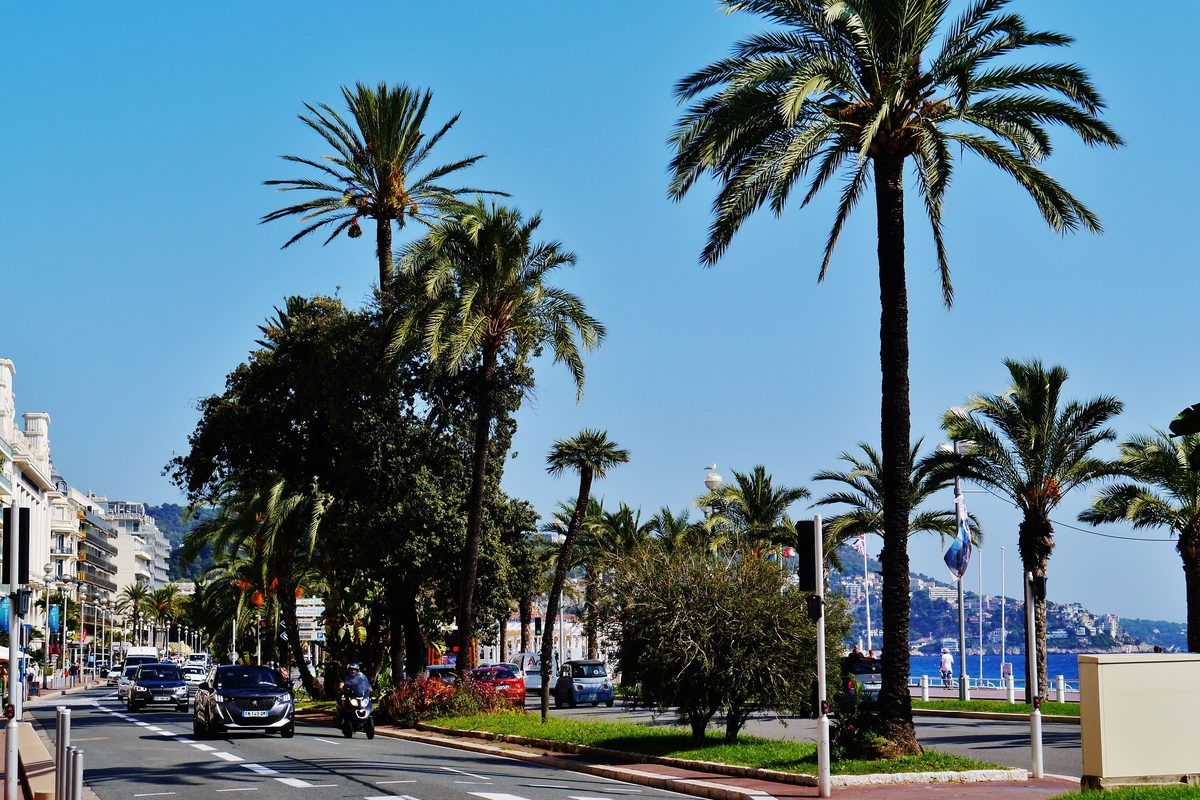
Promenade des Anglais The 7-kilometre coastal boulevard is Nice’s most recognisable feature. Walk it early morning or at dusk, when the light is better. Belle Époque grand hotels line the landward side; the shingle beach and sea are on the other.
Castle Hill (Colline du Château) A lift and stairs at the eastern end of the Promenade climb to the Colline du Château — a terraced park with sweeping views across the Baie des Anges and back over the old town. The panorama is one of the best free things in the city.
Musée Matisse Matisse lived in Nice for nearly 40 years. The museum in Cimiez holds one of the most complete collections of his paintings, drawings, sculptures, and paper cut-outs, inside a 17th-century Genoese villa with Roman-era grounds.
Musée National Marc Chagall Also in Cimiez and quieter than the Matisse. Chagall’s large biblical paintings were designed for this purpose-built museum — the space and the works feel well matched.
Events in Nice
Carnaval de Nice runs for around two weeks in February, centred on the Promenade des Anglais and Place Masséna. Floats parade through the city by day and night; the Battle of Flowers is one of the most celebrated set-pieces. The carnival is one of the largest in Europe — accommodation fills quickly, so book well ahead.
Nice Jazz Festival is held in July, typically over four or five days in the gardens near Place Masséna. It is one of the oldest jazz festivals in the world.
Nice is also the natural base for events elsewhere on the Riviera. The Festival de Cannes (May) is 35 minutes by train; the Monaco Grand Prix (late May/early June) is 25 minutes; the Fête du Citron in Menton (February–March) is 35 minutes east.
Where to Stay in Nice
Vieux Nice and the streets near the Promenade are the most popular areas to stay — the market, the beach, and the tram are all within easy walking distance. The area around Nice-Ville station is quieter and slightly more residential. The port neighbourhood sits at the eastern end of the Promenade, a little further from the old town but still well connected. For the old town itself, Gilli — a two-bedroom apartment on the Cours Saleya managed by Stay YNA — is the one place this site recommends.
Practical Information
Getting around: The city’s two tram lines and bus network cover the main areas. The old town, Promenade, and Castle Hill are all walkable from each other. For trips along the coast, the TER train is the right choice — cheap, frequent, and scenic.
The beach: Nice’s beaches are shingle, not sand. The sea is clear and generally calm for swimming from late May through early October. Sun loungers are available for hire at most beach concessions along the Promenade.
Language: French. English is widely spoken in visitor areas, particularly in the old town, along the Promenade, and in hotels.
Currency: Euro. Card payments are accepted almost everywhere; contactless is standard.
Time zone: Central European Time — UTC+1 in winter, UTC+2 in summer (French Summer Time).
La ligne du littoral The whole coast by train, from Nice
Direct TER trains along the coast — approximate journey times from Nice-Ville. Temps de trajet approximatifs au départ de Nice-Ville.