Carnaval de Nice
What Is Carnaval de Nice?
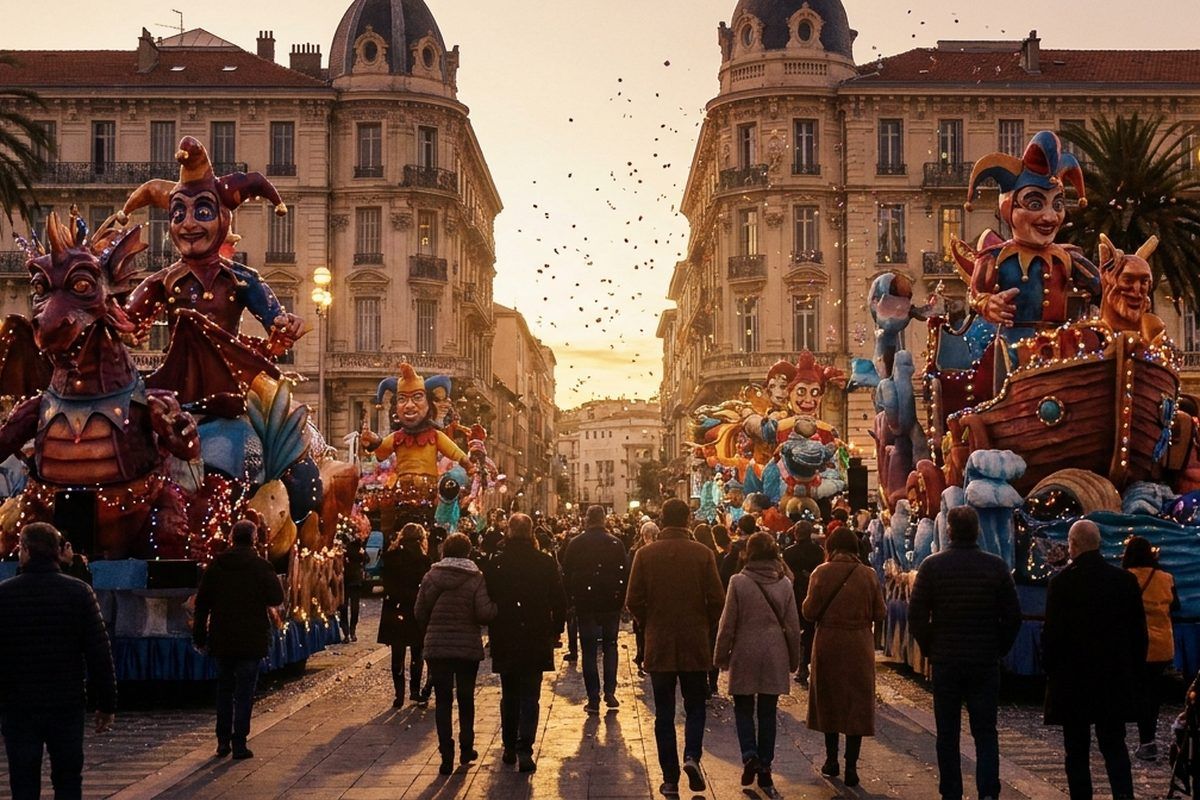
Carnaval de Nice is one of the world’s major carnival celebrations — ranked alongside Rio de Janeiro and Venice in scale, though distinctly Mediterranean in character. Where Rio is spectacle and Venice is mystery, Nice is something closer to a good-natured civic party: two or three weeks of floats, brass bands, flowers, and satirical giant heads taking over the centre of a city that, for the rest of the year, is known more for its beach and its light.
The carnival’s history reaches back to 1294, when Charles of Anjou described spending “joyful days of Carnival” in Nice. The organised modern event — with its float processions and the iconic King of Carnival effigy — took shape in 1873. The batailles de fleurs, the flower-throwing parades that have become the carnival’s most recognisable image, were introduced in 1876 and have continued every year since.
Each edition is built around a new annual theme, announced in autumn. The theme gives shape to the King of Carnival — a monumental papier-mâché effigy, several storeys tall — and influences the satirical and celebratory imagery on the floats. Past themes have ranged from political commentary to popular culture to homages to history; the carnival has always had a sharp, irreverent edge alongside its spectacle.
The event draws hundreds of thousands of visitors across its run. It is, by any measure, the French Riviera’s largest winter event.
When Does Carnaval de Nice Take Place?
The carnival runs for approximately three weeks each year, opening in mid-February and closing in early March — usually on or just after Mardi Gras (Shrove Tuesday), since the carnival calendar is tied to the liturgical year and shifts with the date of Easter.
Within that window, there are typically six to eight parade events: a mix of afternoon and evening corsos carnavalesques (the main float processions) and four batailles de fleurs (the flower battles), held on Wednesday and Saturday afternoons.
Dates for each year’s edition are confirmed in the preceding autumn on the official Nice Carnival website at nicecarnaval.com. Tickets go on sale at the same time. If you are planning a trip around the carnival, check the site as soon as autumn begins — accommodation in Nice fills quickly once the programme is published.
Where Does Carnaval de Nice Take Place?
The principal venue is Place Masséna, Nice’s grand central square, and the streets and promenade immediately surrounding it. The main float circuit runs from Place Masséna westward along the Promenade des Anglais toward the seafront, with grandstands and pedestrian viewing zones set up along the full route.
The Carnival Village — a free-entry entertainment zone with workshops, activities, music, and food stalls — occupies the Promenade du Paillon, the wide green pedestrian avenue that runs from Place Masséna northward toward the Paillon gardens.
Nice’s compact city centre means that almost everything connected to the carnival is within walking distance of Vieux Nice and the main hotel areas. Place Masséna is ten minutes on foot from Vieux Nice and fifteen minutes from Nice-Ville railway station.
How to Get There
The Nice Carnival is an urban event: the city centre is the venue, and the usual advice about driving into Nice applies with extra force during the carnival. Traffic restrictions are in place around Place Masséna and the Promenade des Anglais on event days, and parking near the route is effectively unavailable.
By tram: Tram Line 1 runs east–west through the city and has a stop at Masséna, directly adjacent to the main grandstand zone. It is the most straightforward way to reach the event from anywhere in Nice. From Nice-Ville railway station, the journey takes around five minutes.
On foot from Vieux Nice: Place Masséna is a fifteen-minute walk from the heart of the Old Town, along pedestrianised or low-traffic streets.
From Nice Côte d’Azur Airport: The airport sits approximately 7 kilometres west of the city centre. Tram Line 2 connects the airport to the city, linking to Line 1 at the Jean Médecin interchange. Allow around 35–40 minutes from the airport terminal to Place Masséna by tram.
Parcazur park-and-ride: The city operates several Parcazur park-and-ride sites on the periphery of Nice. Visitors arriving by car can leave their vehicle and travel into the centre by tram or bus. These sites fill on busy parade days; arrive early.
What to See and Do
Corsos carnavalesques (float parades)
The corsos are the centrepiece of the carnival: processions of monumental floats, giant sculpted heads, costume troupes, and international brass bands moving along the circuit from Place Masséna to the Promenade. There are typically two afternoon corsos and two evening corsos per week during the carnival. The nighttime editions are particularly striking — floats illuminated and accompanied by sound, the streets around the square dense with crowds and noise. If you can only attend one event, the evening corso is the one to choose.
Batailles de fleurs (flower battles)
The flower battles are a separate, quieter kind of spectacle. Floats decorated with tens of thousands of fresh flowers — mimosa, gerbera, carnations, and lilies grown in the Alpes-Maritimes hills — process slowly along the Promenade. Performers in elaborate costumes throw blooms into the crowd; catching a flower is considered good luck. The batailles have a gentler tempo than the nighttime corsos and are well suited to visitors who want colour and atmosphere without the late-evening crush.
The King of Carnival
The King — the giant effigy built to that year’s theme — presides over the processions from the first parade to the last. On the final evening, the King is burned in a ceremony on Place Masséna or the Promenade, an ancient rite that marks the end of the carnival and the start of Lent. The burning is free to watch and draws a large crowd.
Village du Carnaval
The Carnival Village on the Promenade du Paillon is open throughout the carnival period and free to enter. It is a good way to experience the atmosphere without buying parade tickets — there is street food, music, activities for children, and carnival-themed workshops. For visitors arriving without pre-booked tickets, the Village is also a useful fallback.
Where to Stay for Carnaval de Nice
The carnival is held entirely within Nice, so staying in the city is straightforward — there is no commute from a neighbouring town to consider. Accommodation in the centre, close to Place Masséna and Vieux Nice, gives you walking-distance access to the main venues and lets you return easily between events.
February is outside the high season, so prices and availability are generally better than in summer. That said, the carnival period is the exception: accommodation near the route fills quickly once dates are announced, particularly for weekends that overlap with the main parades.
Practical Tips
Book tickets early. Grandstand seats for the evening corsos and the Batailles de Fleurs sell out, sometimes weeks in advance. Decide which events you want reserved seating for, and buy as soon as tickets go on sale in autumn.
Full costume means free entry. For the illuminated corsos, a genuine full costume — not a hat and some face paint — qualifies you for free entry to the pedestrian viewing zones. The Bataille de Fleurs requires a ticket regardless. If in doubt, check the current year’s rules on the official site before you travel.
Dress for February. Daytime temperatures in Nice in February typically range from 10°C to 15°C; evenings are cooler. The nighttime corsos can feel cold once you stop moving. Bring a proper coat.
Arrive early. Pedestrian zones along the route fill up well before the parade begins, especially on weekends. For the Bataille de Fleurs in particular, arriving an hour before the start time is reasonable if you want a good position near the front.
Comfortable shoes. Even with grandstand seating, carnival days involve walking on cobbled and uneven surfaces. Prioritise footwear.
Accessibility. The official Nice Carnival website publishes accessibility information for each event year, including details of accessible seating zones and accessible routes to the venue. Check the current year’s guidance if this is relevant to your plans.
Frequently Asked Questions
- Do I need to buy tickets for Carnaval de Nice?
- Tickets are required for grandstand seating and for access to most pedestrian viewing zones. The exception is the illuminated corsos: visitors attending in a full carnival costume — head to toe, not just accessories — can enter the pedestrian zones free of charge. The Bataille de Fleurs requires a ticket regardless of costume.
- What is the difference between the corsos and the batailles de fleurs?
- The corsos carnavalesques are the main float parades, with both afternoon and nighttime editions. The nighttime versions feature illuminated floats and are the most dramatic. The batailles de fleurs are separate afternoon events — typically on Wednesdays and Saturdays — where performers on floral floats throw freshly cut flowers into the crowd.
- When are dates for Carnaval de Nice announced each year?
- Dates are published each autumn on the official Nice Carnival website at nicecarnaval.com. The carnival typically runs for around three weeks in mid to late February, finishing in early March around Mardi Gras. Exact dates shift slightly depending on when Easter falls each year.
- Is the carnival suitable for children?
- Yes. The daytime float parades and the free-entry Carnival Village on the Promenade du Paillon are well suited to families. Evening illuminated corsos run late; grandstand seating gives younger children a clear, contained view without the jostling of pedestrian zones.