Festival de Cannes
What Is the Festival de Cannes?
The Festival de Cannes — known internationally as the Cannes Film Festival — is one of the world’s most prestigious cinema events. Held each year in Cannes on the French Riviera, it brings together filmmakers, producers, distributors, and actors from across the globe for twelve days of screenings, deals, premieres, and red-carpet ceremonies. The Palme d’Or, awarded to the best film in the main competition, is among the most coveted prizes in cinema.
The festival operates on two parallel tracks: an industry marketplace — the Marché du Film, the world’s largest film market — and a curatorial showcase for the Official Selection, which includes the main Competition, Un Certain Regard, and a number of parallel sections. These two tracks run simultaneously, and mostly invisibly to those arriving without credentials.
For visitors coming without industry accreditation, the honest answer is this: you are not attending the film festival in the professional sense. You are attending the event around it. That is still genuinely worth doing.
When Does the Festival de Cannes Take Place?
The festival runs each year for twelve days in mid-to-late May. It typically opens on a Tuesday and closes the following Saturday with the awards ceremony. Exact dates are announced by the festival well in advance, usually confirmed by the end of the preceding year; check the official festival website for the current edition’s schedule.
Plan around mid-May through to approximately the 23rd in a typical year. The Opening Ceremony and Closing Ceremony are the most visually striking public moments, framing the fortnight’s procession of premieres.
Where Does the Festival de Cannes Take Place?
The main venue is the Palais des Festivals et des Congrès, a large purpose-built convention centre at the eastern end of La Croisette — Cannes’ famous beachfront boulevard. The Palais houses the main screening theatres, including the Grand Théâtre Lumière with around 2,300 seats, as well as the Marché du Film and the accreditation offices. Without a badge, you will not enter.
The festival spills well beyond the Palais, however:
- La Croisette is the public spine of the event. Walking its length past the grand hotels — the Carlton, the Majestic, the Grand Hyatt — gives a vivid sense of the scale and spectacle: giant film posters draping hotel facades, camera crews at every corner, industry figures in evening wear alongside tourists in shorts.
- Le Suquet, the old quarter on the hill above the port, offers a quieter contrast and is worth an afternoon for its own sake.
- The Lérins Islands, a short boat trip from the old port, provide a calm escape from the Croisette’s noise. The islands are reachable even during the festival and make a good half-day.
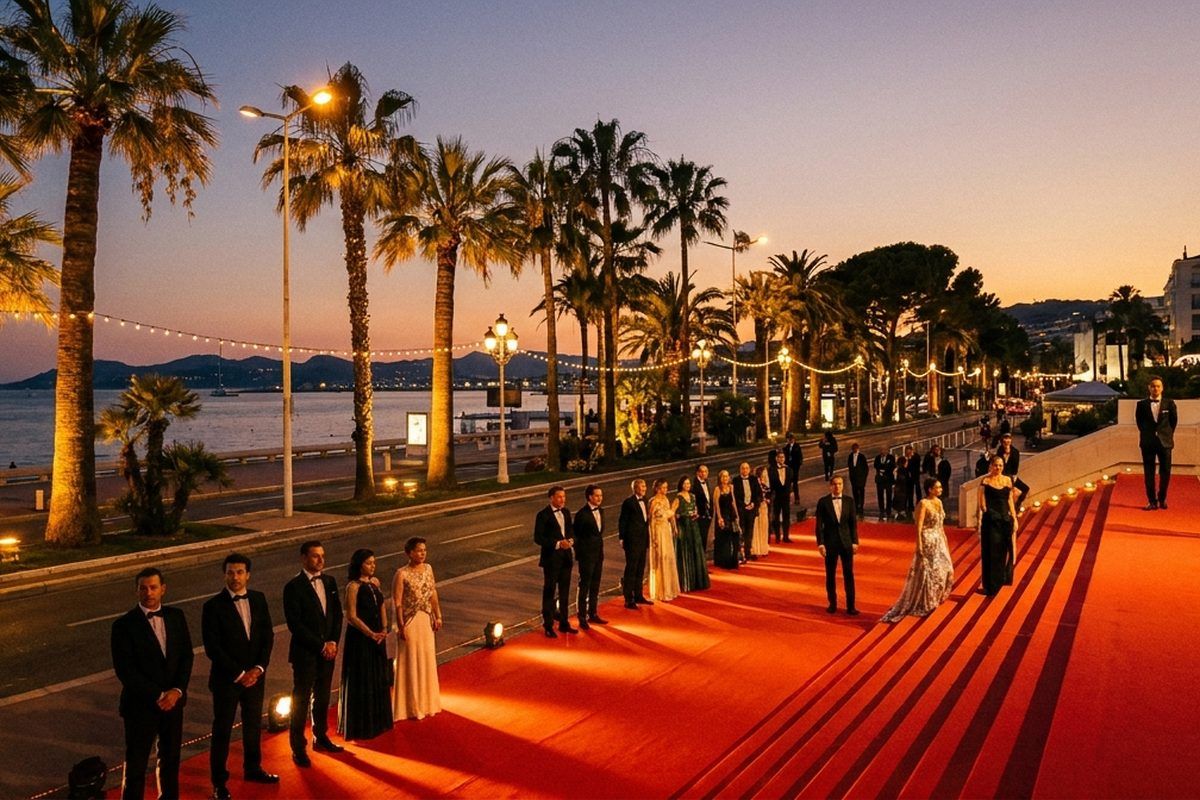
The famous red steps — the Montée des Marches — lead up to the Palais entrance. Each evening, the cast and crew of a film in competition ascend them in formal dress. This is the defining image of the festival, and watching it from the public barriers on the street below is free.
How to Get There
By train from Nice: The most practical option for visitors based in Nice. TER trains between Nice-Ville and Cannes run roughly every 15 minutes throughout the day, with the journey taking around 30 minutes. Fares are very reasonable — typically under €10 each way. During the festival, trains can be busy; travelling mid-morning or mid-afternoon tends to avoid the worst of it. The walk from Cannes train station to the Palais des Festivals is around 15 minutes, mostly along the Rue d’Antibes and down to the Croisette.
By car: Driving into central Cannes during the festival is slow and parking is limited. The train is strongly preferred for day trips.
From Nice Côte d’Azur airport: The airport is around 25 kilometres west of Cannes. You can reach Cannes by taxi or shuttle directly from the terminal, or by connecting to Cannes via Nice-Ville by rail.
What to See and Do
The Red Carpet (Montée des Marches)
Each evening during the festival, the procession up the Palais steps is the signature public spectacle. Public viewing is from barriers on the pavement below the steps — access is free, arrival time is everything. If you want a front-row spot for a major premiere, arrive well before the scheduled time; the procession itself typically lasts 20 to 40 minutes. What you see depends on who is walking that evening; the official programme, published on the festival website, lists which film is screening each day.
Cinéma de la Plage
Every evening from 9:30 PM during the festival, Plage Macé on La Croisette hosts a free open-air cinema facing the Mediterranean. The programme includes world premieres, restored classics from world cinema, and films from the Official Selection — and the cast sometimes makes a brief appearance on stage before the screening. Bring a light jacket; May evenings on the beach can be cool once the sun has gone down. Arriving by 9:00 PM gives you a good chance of a sun lounger; the screenings are popular and fill up.
This is the most substantive film-watching option available to visitors without accreditation, and it is genuinely good.
The Atmosphere on La Croisette
Even without any credentials, a day on La Croisette during the festival is worth experiencing. The sheer scale of the publicity — giant posters on hotel facades, satellite trucks parked end to end, the hum of deals being made in hotel lobbies — gives a rare window onto the film industry at full stretch. The hotel bar terraces are accessible to anyone prepared to pay for a drink; the atmosphere is something between a trade fair and a carnival.
For Film Enthusiasts Aged 18 to 28
The festival runs a “3 Days in Cannes” accreditation programme aimed at young film enthusiasts, granting limited access to some Official Selection screenings on a first-come-first-served basis (with industry professionals given priority). Applications open several months before the festival and are submitted via the official website. Separately, the Cinéphiles accreditation — a long-running programme — provides access to films in the Official Selection and parallel sections at some Cannes cinemas. If watching actual competition films is your goal, these programmes are your clearest routes.
Where to Stay for the Festival de Cannes
Cannes accommodation during the festival fills quickly and prices rise substantially. Many visitors choose to base themselves in Nice and make the journey by train, which takes around 30 minutes and runs frequently. Nice also offers more to do on days spent away from Cannes, and its range of accommodation is generally wider and better value during the festival period.
Practical Tips
- Book accommodation early. If you want to stay in Cannes itself, do so months in advance. Nice offers more availability and flexibility.
- No evening wear required. Formal dress is required only for official screenings with an invitation. For the Cinéma de la Plage or public red-carpet viewing, come as you are.
- Go in the morning. The Croisette atmosphere builds through the day; mornings are calmer and more pleasant for walking, eating, and taking in the setting.
- Check the Cinéma de la Plage programme. It is published on the festival website each year; some screenings draw larger crowds than others.
- Keep valuables secure. Cannes during the festival is very crowded; the usual precautions apply.
- The walk from the station is manageable. Cannes-Ville station to the Palais is around 15 minutes on foot along flat streets — no need for a taxi from the station.
Frequently Asked Questions
- Is the Cannes Film Festival open to the public?
- The festival is primarily an industry and press event. The Palais des Festivals and most official screenings require professional accreditation. However, the Cinéma de la Plage — free open-air screenings on Plage Macé each evening from 9:30 PM — is open to everyone, and the red-carpet Montée des Marches can be watched from public barriers at no cost.
- How can I watch films at Cannes without professional accreditation?
- The Cinéma de la Plage offers free nightly screenings of films from the Official Selection and restored classics on the beach, open to all. If you are aged 18 to 28, the festival's '3 Days in Cannes' programme grants limited access to some Official Selection screenings — applications open several months in advance on the festival website. The Cinéphiles accreditation provides similar access at some Cannes cinemas.
- How do I get to Cannes from Nice during the festival?
- TER trains between Nice-Ville and Cannes run roughly every 15 minutes and take around 30 minutes. Fares are typically under €10 each way. This is the most practical option — driving into Cannes during the festival is slow and parking is difficult.
- Do I need formal evening wear to attend?
- Only if you hold an official invitation to a formal screening. For the Cinéma de la Plage or red-carpet viewing from the public barriers, there is no dress code.