Festival de Musique de Menton
What Is the Festival de Musique de Menton?
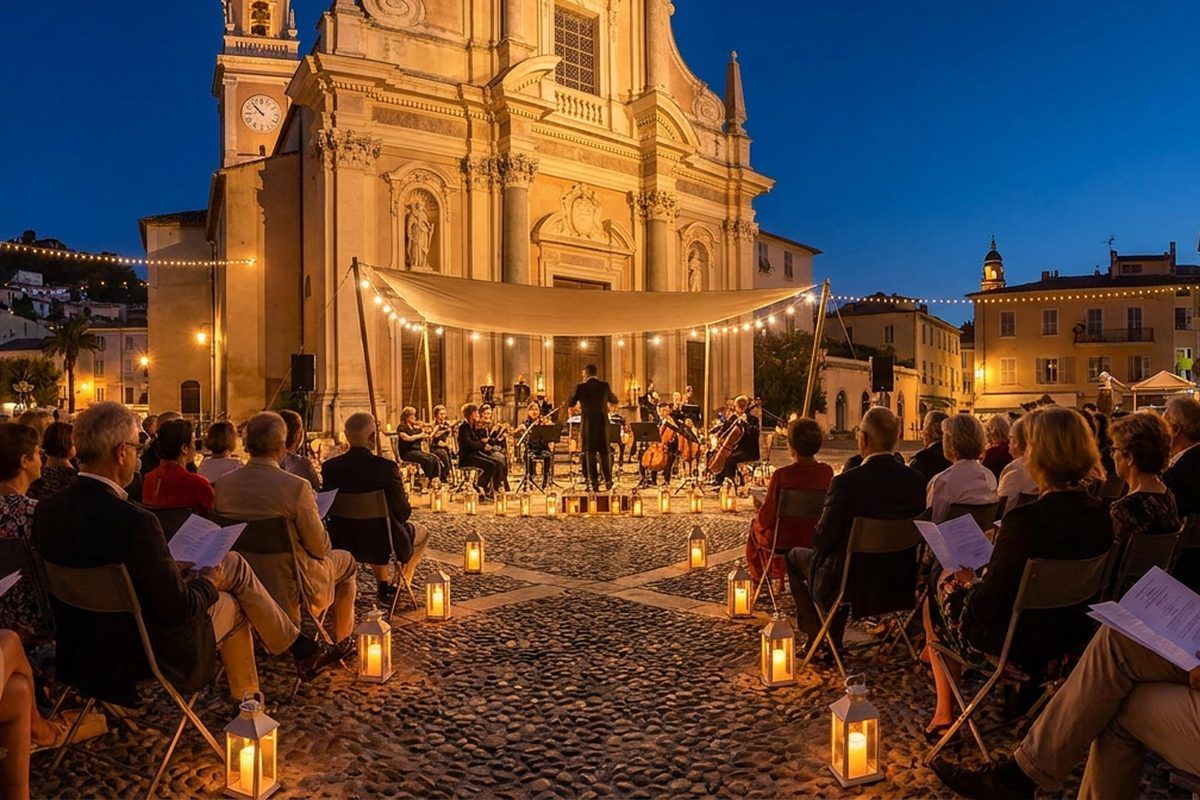
The Festival de Musique de Menton is one of the oldest classical music festivals in France. It was founded in 1950 by André Böröcz, a Hungarian-born musician who had discovered Menton’s baroque old town almost by chance the previous summer. Walking through the deserted alleys one August afternoon, he heard Jascha Heifetz performing Bach’s Second Partita through an open window. The encounter between music, warm stone, and Mediterranean light struck him as something worth repeating deliberately — and on 5 August 1950, the Végh Quartet performed Haydn, Mozart, and Beethoven on the parvis of the Basilique Saint-Michel Archange for the first time.
Seventy-seven editions later, the principle remains unchanged. World-class musicians perform on the same forecourt, backed by the same polychrome baroque facade, with the same Ligurian Sea visible from the heights of the old town below.
The festival has hosted Sviatoslav Richter, Mstislav Rostropovich, Isaac Stern, Maria-João Pirès, and Jean-Pierre Rampal among its past artists. It has been directed by Paul-Emmanuel Thomas since 2012, and the programme continues to attract musicians of international standing — not as a regional curiosity, but as a festival that could hold its own in any major European city.
When Does the Festival de Musique de Menton Take Place?
The festival runs for approximately two weeks in late July and early August, with around fifteen concerts in total. In 2026, the 77th edition runs from 25 July to 7 August.
Concerts on the Esplanade of the Basilica typically begin in the evening — a 9pm start is common, making the most of the fading summer light. Recitals at the Palais de l’Europe tend to begin a little earlier. The full programme, with confirmed concert times, is published on the festival’s official website each spring.
Where Does the Festival de Musique de Menton Take Place?
The principal venue is the Parvis of the Basilique Saint-Michel Archange — the broad forecourt of the baroque church at the heart of Menton’s old town. The setting is exceptional: the basilica’s polychrome facade closes the square on one side, the terraced rooftops of the old town rise on the others, and on clear evenings the Mediterranean is visible below the hill. The open space has good natural acoustics for chamber and solo work, and the ambient temperature on a July or August evening makes outdoor concerts comfortable well into the night.
A second venue, the Palais de l’Europe, hosts smaller chamber recitals and solo programmes in a more enclosed setting. The Parc du Pian has also been used for additional performances in some editions.
How to Get There
By train. The most practical route is the SNCF TER regional service from Nice-Ville station to Menton — a direct journey of around 35 minutes. Around 46 trains run on this route each day, from early morning until late evening, so both early arrivals and returns after a concert are straightforward. Visitors based in Monaco can reach Menton in approximately 15–20 minutes by train.
Festival shuttle. The walk from Menton’s main station up to the Parvis Saint-Michel is pleasant, but it is uphill and involves stepped streets through the old town. The festival operates a dedicated shuttle from in front of the Menton Tourist Office at 8 avenue Boyer, with departures at 7:45pm and 8:15pm. The return ticket costs €5. Places are limited, so reserve through the Tourist Office in advance rather than assuming availability on the night.
By car. Menton is accessible from the A8 motorway and the coastal road. Parking in and near the old town is limited at the best of times; on concert evenings it becomes substantially harder. For most visitors the train is the sensible choice.
What to See and Do
The concerts themselves are the reason to come — but the setting does work the experience cannot do alone. Arriving at the parvis on a warm August evening, with the light still soft behind the basilica and the smell of the old town in the air, is different from attending a concert hall. The architecture is not incidental backdrop; it is genuinely part of what the festival has always offered.
The programme ranges widely across the classical repertoire. Solo piano recitals sit alongside string quartets, violin and cello programmes, and occasional vocal performances. The 2026 edition features Gautier Capuçon, Leonidas Kavakos, Fazıl Say, and Alexandre Kantorow among its headliners. Past editions have consistently drawn artists who do not require a scenic backdrop to justify the ticket price — the music stands on its own, and the parvis adds to it.
For visitors with time to spend in Menton beyond the concert evenings, the town repays exploration. Its architecture reflects a long Italian influence — the painted facades and campaniles of the old town look more Ligurian than Provençal — and the gardens are among the most varied on the Riviera. The Jardin Serre de la Madone and the Jardin Botanique Exotique du Val Rahmeh are both worth a visit. The beaches along the Promenade du Soleil are noticeably quieter than those further along the coast towards Nice and Cannes.
Where to Stay for the Festival de Musique de Menton
Menton is a small town, and accommodation books up quickly during the festival fortnight. Many visitors choose to stay in Nice and travel in for individual concerts — the train connection makes this an easy arrangement, particularly for later evening performances.
Practical Tips
Book tickets early. Headline solo recitals in particular sell out well in advance. Multi-concert passes — covering seven or more concerts — offer better value per event and are worth considering if you plan to attend several performances. Tickets are available through the festival website and at the Menton Tourist Office.
Reserve the shuttle. If you intend to use the festival shuttle from the Tourist Office, reserve your place in advance. Seats are not guaranteed on the night.
Bring a layer. August evenings on the Riviera are generally warm, but the parvis sits on high ground with an open aspect. A light jacket or wrap is sensible once the sun is fully down.
Arrive with time to spare. The old town of Menton is worth half an hour on its own before a concert. Arriving in Menton early enough to walk up through the streets and reach the parvis without rushing makes the experience considerably better.
Dress. Smart casual is comfortable and appropriate. Evening dress is common among regular attendees, but the festival has no formal dress requirement.
Frequently Asked Questions
- What type of music is performed at the Festival de Musique de Menton?
- The festival focuses entirely on classical music: solo recitals, chamber music, and piano and string programmes performed by internationally acclaimed musicians. The repertoire spans baroque to contemporary, with a strong emphasis on the core classical and romantic canon.
- Is the Festival de Musique de Menton a ticketed event?
- Yes. Tickets are required for all concerts. Esplanade concerts range from around €29 to €70 depending on seating category; Palais de l'Europe recitals are typically around €20. Multi-concert passes are available and offer better value. Book early through the festival website or the Menton Tourist Office — popular concerts sell out.
- How do I get from Nice to the Festival de Musique de Menton?
- Take a direct SNCF TER train from Nice-Ville to Menton, around 35 minutes. A festival shuttle then runs from the Menton Tourist Office at 8 avenue Boyer at 7:45pm and 8:15pm, costing €5 return. Shuttle places are limited, so reserve ahead through the Tourist Office.
- Where exactly does the festival take place?
- The main concerts are held on the Parvis of the Basilique Saint-Michel Archange — the forecourt of the baroque church in Menton's old town, overlooking the Mediterranean. Chamber recitals and some programmes also take place at the Palais de l'Europe nearby.