3 Days in Nice: An Itinerary for First-Time Visitors
Trois jours à Nice
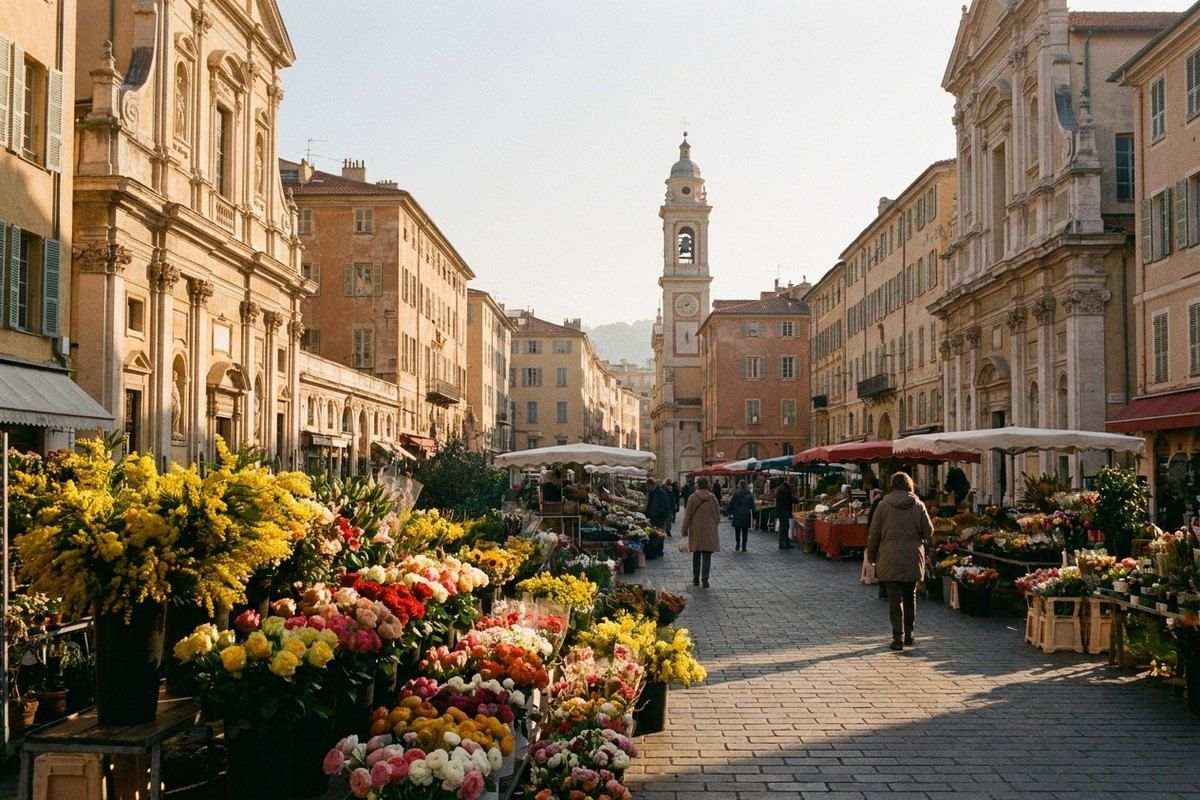
Three days is enough time to arrive properly in Nice — to walk the old town slowly, sit at the Cours Saleya with coffee, take a bus up to the museums in Cimiez, and still have a full day left for the coast. This itinerary keeps your base in Nice for all three nights. The train network is good enough that there is no need to move.
The days below are paced, not rushed. Nice rewards time spent in the same place.
Day 1: Vieux Nice and Castle Hill
Start at the Cours Saleya. The market runs Tuesday to Sunday, morning into afternoon — flowers and produce from early, socca (a thin chickpea pancake, Nice’s most local street food) from stalls near the covered end. Monday is brocante day: antiques replace the flowers. Both versions are worth seeing, but arrive before noon to get the market at its fullest.
From the market, Vieux Nice is immediately behind you. The old town is a compact grid of narrow streets in the Ligurian baroque style — ochre and terracotta facades, shuttered windows, the occasional line of washing overhead. Walk north along Rue de la Poissonnerie or Rue du Marché and work your way toward Rue Droite, the old town’s main spine. Halfway along it is the Palais Lascaris, a 17th-century baroque mansion managed as a free museum. The collection of historical musical instruments inside is genuinely unusual; allow twenty minutes.
Place Rossetti sits at the heart of the old town, with the Cathédrale Sainte-Réparate on one side and Fenocchio — one of Nice’s oldest ice cream shops, with an extensive list of unusual flavours — on the other.
End the afternoon at the Colline du Château — Castle Hill. A free lift operates at the eastern end of the Promenade des Anglais; there are also stairs. The fortress no longer stands, but the terraced park at the top gives one of the best panoramas in the city: the curve of the Baie des Anges to the west and the old town rooftops directly below. Late afternoon, when the light hits the bay, is the best time to go.
Day 2: Museums, the Promenade, and the Port
Both of Nice’s major art museums are in Cimiez, the hill district north of the city centre. Bus 5 from central Nice serves both on the same route — the Musée National Marc Chagall comes first, then the Musée Matisse a few stops on.
The Chagall museum is small and purpose-built. The large biblical paintings were designed for this specific space, and the relationship between the building and the work is unusually well judged. The Matisse museum occupies a 17th-century Genoese villa surrounded by olive trees and Roman-era ruins. Matisse lived in Nice for nearly 40 years; the collection spans paintings, drawings, sculptures, and cut-outs from across that long residency. Doing both in a single morning is practical; if you want more time in either, pick one and return to the other on another day.
Back in the city, the afternoon belongs to the Promenade des Anglais. The seafront boulevard runs 7 kilometres along the bay — walk a section of it west from Place Masséna. The pebble beach below is accessible the full length of the route, either at one of the paying concessions or at the free public sections between them.
For dinner, the port neighbourhood east of Castle Hill is a quieter alternative to the old town. The restaurants around Place Île de Beauté have a more local feel in the evenings.
Day 3: A Trip along the Coast
Nice-Ville station is the starting point. The TER coastal train runs east roughly every 15–30 minutes. Monaco is 25 minutes away; the fare is around €5 each way. The journey itself is scenic — the line passes through Villefranche-sur-Mer, Beaulieu-sur-Mer, and Èze-sur-Mer before reaching Monaco. Villefranche has a deep natural harbour and a quieter beach; it is worth a stop on the return if the timetable allows.
In Monaco, the Palais Princier (the Prince’s Palace) sits on the Rock — the fortified headland above the old port — and is open to visitors through most of the year. The Musée Océanographique, also on the Rock, is one of the more serious aquariums on the Riviera. Below, the Formula 1 circuit runs through the streets of Monte-Carlo; you can walk sections of it at any time.
Antibes is the alternative: 20 minutes west by train, with a substantial old town and the Musée Picasso housed in the Château Grimaldi where Picasso worked for several months in 1946. Cannes is 35 minutes west, the better choice if boulevard atmosphere and a wide sandy beach are what you are after.
Practical Tips
Tram and bus within Nice. The Lignes d’Azur network covers the city well. A single ticket is valid for 74 minutes with unlimited transfers. Tram Line 1 connects Nice-Ville station with Place Masséna and the edge of Vieux Nice. Bus 5 goes up to Cimiez for the museums.
Driving. There is no good reason to drive within Nice. Traffic around the old town is restricted and parking is difficult. Use the tram.
Market timing. The Cours Saleya market runs Tuesday to Sunday; Monday is antiques. It winds down in the early afternoon — before noon is the right time to be there.
Coastal trains. Buy tickets at the station or via the SNCF Connect app. No reservation is required; the service is frequent and cheap.
Footwear. Vieux Nice is cobbled throughout. Comfortable shoes will improve every day of this itinerary.
Where to Stay in Nice
Staying in Vieux Nice keeps everything in this itinerary within walking distance — the Cours Saleya market, Castle Hill, the beach, and the tram to the Cimiez museums. Gilli, a two-bedroom apartment on the Cours Saleya managed by Stay YNA, sleeps six and is 100 m from the beach.