Nice and Monaco Weekend Itinerary
Un week-end entre Nice et Monaco
About This Weekend
Two cities, two days — one of the more rewarding short breaks on the French Riviera. Nice is the practical base: a city with its own distinct identity, markets, and food that justify staying rather than simply passing through. Monaco is twenty minutes away by regional train, a contrast in scale and ambition that fills a full day well.
This itinerary works throughout the year, though late spring and early autumn offer agreeable weather and lighter crowds than the July–August peak. The train connection means no car and no advance booking — just a ticket bought at the station on the day.
Day One: Nice
Morning — Vieux Nice and the Cours Saleya
Begin in Vieux Nice, where seventeenth and eighteenth-century streets remain largely intact. The architecture is Italianate — Nice was part of the Kingdom of Sardinia until 1860 — with ochre and terracotta facades, shuttered windows, and narrow alleys that reward slow exploration.
The Cours Saleya runs along the southern edge of the old town. Tuesday through Sunday mornings it hosts a flower and food market, one of the liveliest on the Riviera, with stalls selling cut flowers, local olives, cheeses, socca (a chickpea flatbread, a Niçois speciality), and seasonal produce. Arrive before eleven; stalls begin packing away by early afternoon.
Afternoon — The Promenade and Castle Hill
Walk west along the Promenade des Anglais — seven kilometres of seafront with the Baie des Anges opening out to one side and the city on the other. Nice’s beaches are galets (white pebbles, not sand), a fact worth knowing before committing to a swim.
At the eastern end of the promenade, Colline du Château — Castle Hill — rises sharply above the old town. No castle remains; it was demolished in the early eighteenth century. The park that replaced it has terraced gardens, a waterfall, and panoramic views across the bay and port. Free lifts connect from the promenade level.
Evening — Dinner in the Old Town
Vieux Nice has a dense concentration of restaurants. The local cuisine draws on both Niçois tradition and the proximity to Italy: pissaladière (caramelised onion tart with anchovies and olives), pan bagnat (the local tuna and olive sandwich), and a range of pasta and fresh seafood. The streets around Place du Palais de Justice are worth exploring on foot before settling on a table.
Day Two: Monaco
Morning — The Rock and the Oceanographic Museum
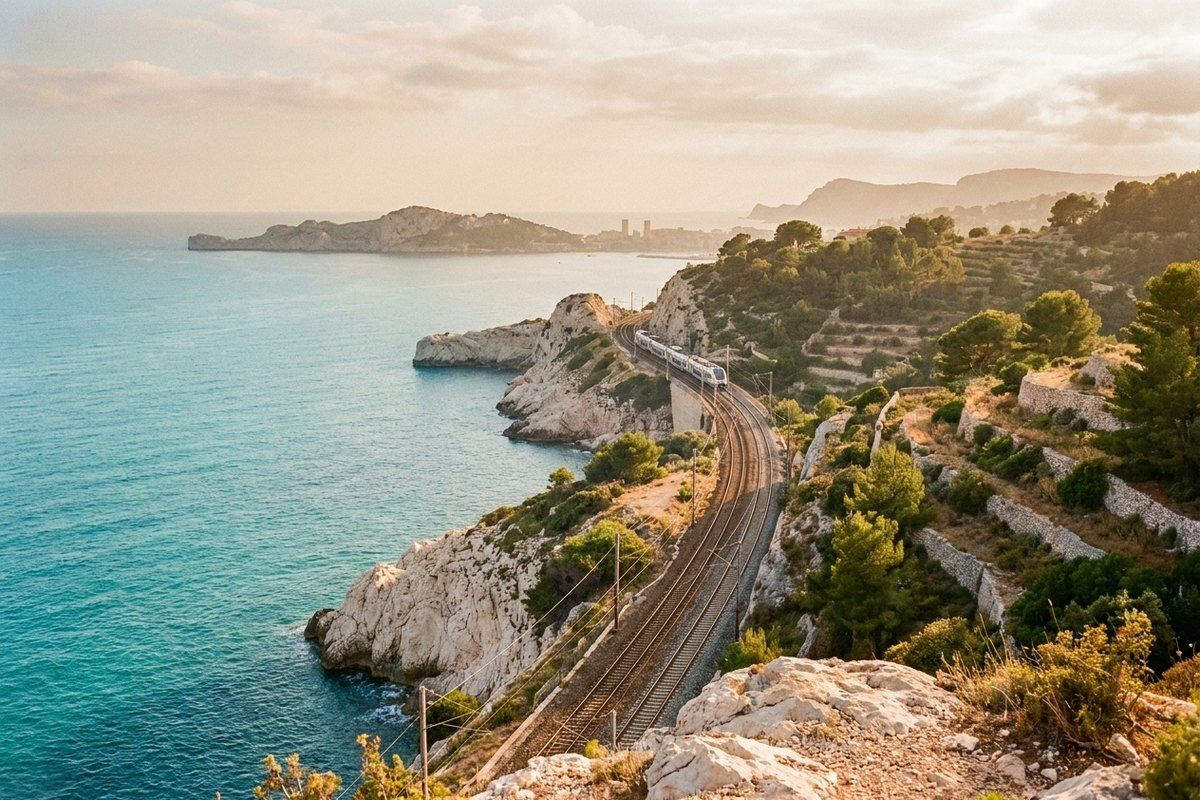
Take a direct TER train from Nice-Ville to Monaco-Monte-Carlo. The line follows the coast through Villefranche-sur-Mer and past Èze-Bord-de-Mer; the journey takes around twenty minutes. Trains run frequently, no reservation is needed, and a single ticket costs a few euros.
Monaco-Ville — the Rock, or Le Rocher — is the original fortified settlement of the principality, perched on a headland above the sea. The Prince’s Palace occupies the western tip; the Changing of the Guard takes place daily at 11:55am precisely. The ceremony is brief but draws a crowd — arriving by 11:45am gives a decent position.
The Musée Océanographique sits at the Rock’s edge, its southern façade dropping almost sheer to the sea. Founded in 1910 by Prince Albert I, it holds large live aquarium tanks, historical deep-sea equipment, and exhibitions on ocean conservation. Allow at least ninety minutes.
Afternoon — Monte-Carlo and the Casino
From the Rock, free public lifts (ascenseurs publics) connect down to the lower town. Monte-Carlo, on the slopes above Port Hercule, is the commercial heart of the principality and contains the most recognisable buildings in Monaco.
The Casino de Monte-Carlo, opened in 1863 and home to the opera house Charles Garnier added in 1878–79, dominates Casino Square. The gaming rooms open each afternoon; entry requires a valid passport and a minimum age of eighteen, and there is a cover charge. The building and the square in front of it can be admired freely at any time.
Walk down to Port Hercule before heading back — the harbour offers the clearest view of how Monaco’s geography has shaped its character, with the Rock above and the city climbing the hillside behind.
Getting Back
Trains back to Nice-Ville run throughout the evening, twenty minutes in either direction. The last services run well into the night; there is no need to rush.
Where to Stay
Practical Information
Best time for this weekend. Late April through early June, or September to October. Crowds and prices in July and August are considerably higher.
Getting between cities. The TER train requires no advance booking. Buy at Nice-Ville station or on the Trainline or SNCF Connect app. Journey time is approximately twenty minutes.
At the Casino. A passport is required to enter the gaming rooms — it is checked at the door. Smart-casual dress is expected in Monte-Carlo; trainers and beachwear are not appropriate in the Casino or the better restaurants nearby.
Nice’s beaches. Smooth white pebbles, not sand. Waterproof sandals make reaching the water considerably more comfortable; paid sunlounger hire is available along most of the promenade.
Grand Prix timing. If this weekend coincides with the Monaco Grand Prix (late May or early June), expect higher prices and busier trains. The atmosphere in Monaco during race week is unlike any other time of year, but it requires earlier planning. See the Monaco Grand Prix guide for full details.