Cours Saleya: Nice's Market Square, Complete Guide
Cours Saleya : le cœur du marché niçois
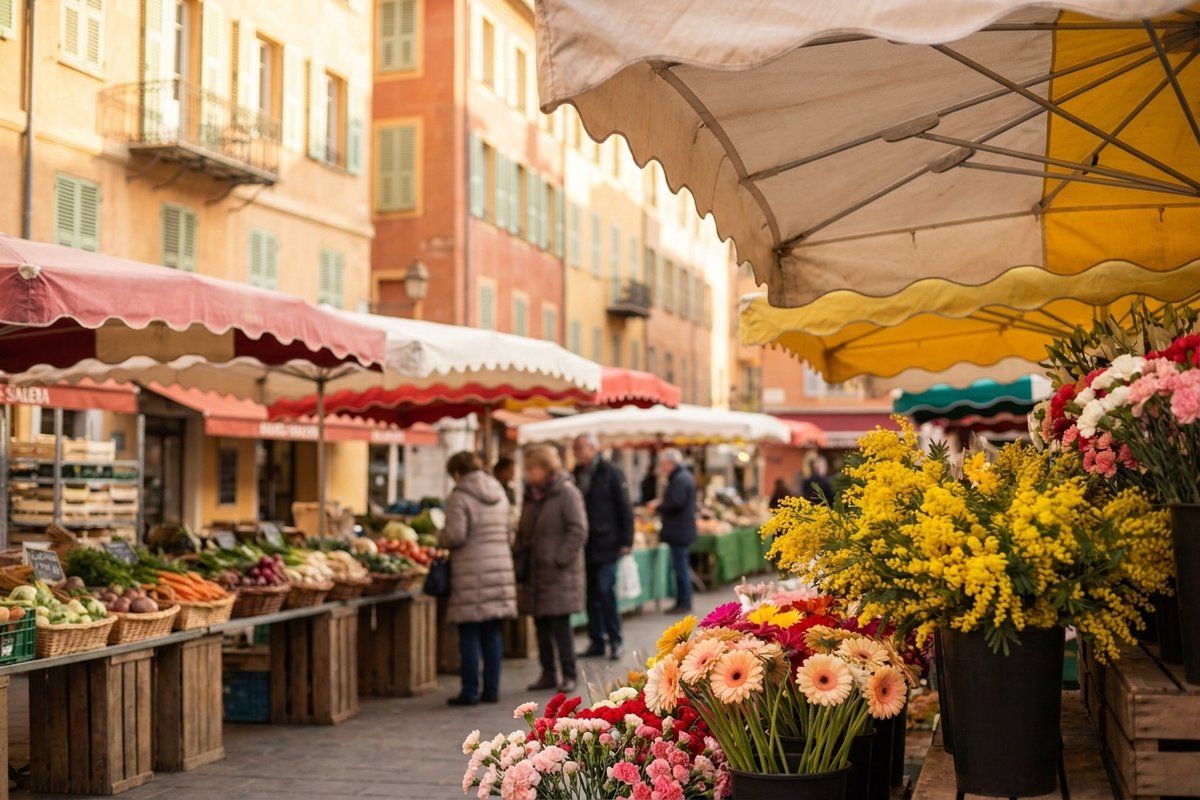
The Cours Saleya has been Nice’s market square since 1861 — flowers and produce from Tuesday to Sunday, antiques on Monday, and a Baroque backdrop that includes the building where Matisse lived for seventeen years, looking down on the stalls from his apartment window.
Why Visit the Cours Saleya?
If Vieux Nice has a single centre of gravity, this is it. The Cours Saleya is a long, open square running parallel to the seafront, a few steps back from the Quai des États-Unis — market by day, restaurant terraces by night, and the address most visitors to Nice’s old town end up returning to more than once during a stay.
What makes it more than a pretty market is the layering: an eighteenth-century Baroque chapel roughly midway along one side, the city’s opera house alongside it, an apartment building at the far end where one of the twentieth century’s major painters lived and worked for the best part of two decades, and a market tradition that has run without a significant break since the mid-nineteenth century. Few squares this size carry this much.
The Markets: Flowers, Produce, and Monday Antiques
The flower and produce market runs Tuesday to Sunday. Flower stalls trade from 6am to around 5:30pm (Sunday until early afternoon), while the fruit, vegetable, and local-produce stalls tend to wind down by early afternoon — arrive before midday to see the square at its fullest and busiest. The Nice tourist office dates the flower market to 1861, and it is regularly cited among France’s most picturesque markets.
Monday is different. The flower and produce stalls stand down, and antiques and brocante dealers move in instead, trading from roughly 7am to 6pm — furniture, old books, paintings, and general bric-a-brac rather than tourist souvenirs. Bargaining is normal, and dealers are generally more willing to negotiate as the afternoon wears on and packing-up time approaches.
In summer, the square has a third life: from mid-May to mid-September, an evening arts-and-crafts market runs alongside the restaurant terraces from around 6pm to half past midnight, Tuesday to Sunday.
A Brief History
The square sits at the heart of what was, for centuries, Nice’s social and commercial life. Under the Kingdom of Piedmont-Sardinia — Nice belonged to the House of Savoy until 1860 — carnival festivities were staged here for the visiting king, and through the second half of the nineteenth century the Nice Carnival’s own float processions paraded across the Cours Saleya before eventually moving to the Promenade des Anglais and then Place Masséna. Place Charles-Félix, at the square’s eastern end, takes its name from the Savoyard king who wintered in Nice.
The Chapelle de la Miséricorde, roughly midway along the square’s northern side, was built between 1747 and 1770 on the site of former royal salt warehouses, to a plan by the Turin architect Bernardo Antonio Vittone. Behind its ochre-yellow façade is an elliptical Baroque nave flanked by lateral chapels that are also elliptical, with murals and abundant gold and stucco ornament — classified as a historic monument and still owned by the confraternity of Black Penitents who hold services there.
The Opéra de Nice stands immediately alongside the square. The current building dates from 1885, when the city rebuilt the theatre after a fire destroyed the previous structure in March 1881, mid-performance of Lucia di Lammermoor. The architect, François Aune, built to a design given the apparent approval of Charles Garnier — the architect behind the Paris and Monte Carlo opera houses — and the reconstructed theatre reopened with Verdi’s Aida.
At the square’s far end stands Place Charles-Félix, where Henri Matisse rented an apartment from 1921 to 1938 — first on the third floor, then, from 1927, the fourth floor, with a terrace looking down over the flower stalls and out to the sea. It was here, in the light he painted so often, that Matisse worked through much of his Nice period.
What to Eat
Socca is the dish most associated with this square. It is a thin, savoury pancake made from chickpea flour, olive oil, and water, baked quickly in a wood-fired oven on a wide copper pan and served hot in rough wedges, seasoned simply with black pepper. It began as a working people’s snack sold from carts around Nice’s markets in the early twentieth century, and stalls selling it directly on or near the Cours Saleya carry on that tradition today.
Beyond socca, the square and the streets immediately behind it are where Niçoise cooking is easiest to find: salade niçoise assembled from what’s genuinely in season rather than a fixed recipe, pissaladière (a soft onion tart with olives and anchovy), farcis (stuffed vegetables), and pan bagnat, the region’s answer to a sandwich, all appear on menus within a few minutes’ walk. Market-day mornings are also when small stalls sell ready-to-eat items alongside the produce — worth a slow walk through before deciding where to sit down.
Evening on the Cours Saleya
Once the market stalls are cleared away, the square changes character completely. Restaurant terraces occupy much of the space that held flower stands that same morning, and by early evening the Cours Saleya is one of the liveliest places to eat in the old town — busy, sociable, and lit warmly against the ochre and terracotta facades behind. It suits a long dinner more than a quick one; service on a summer evening is not rushed, and neither, generally, are the diners.
Connecting to the Promenade and Castle Hill
The square’s position is part of its appeal: it sits only a couple of minutes’ walk from the Quai des États-Unis and the start of the Promenade des Anglais, so an evening on the Cours Saleya connects easily to a walk along the seafront either before or after dinner.
At the square’s eastern end, stairways off Rue des Ponchettes climb toward the Colline du Château — Castle Hill — a steep fifteen-minute walk up several hundred steps (a free lift also runs from the same corner for anyone who would rather not climb). The hilltop park at the top gives a wide view back down over the market square, the old town roofs, and the curve of the Baie des Anges — a good way to see the Cours Saleya’s place in the city from above once you’ve experienced it from ground level.
Practical Information
Noise and timing. Market stalls are set up from before dawn, and the metal-framed awnings and delivery vans do generate real early-morning noise on market days — worth knowing if you’re a light sleeper staying in a building directly on the square. The upside is symmetrical: nowhere in Nice puts the market this literally outside the window.
Crowds. The square is busiest from mid-morning to early afternoon on market days, and again during the evening dinner service. Early risers get a genuinely different, quieter version of the same place.
Access. The Cours Saleya is pedestrianised and flat along its length, though the surrounding old-town streets are narrow and sometimes cobbled. The nearest tram stop, Cathédrale–Vieille Ville, is a short walk away on Line 1.
Accessibility of the buildings. Old Nice’s building stock is centuries old. Many apartments and some smaller hotels around the square are walk-ups without a lift — worth checking directly if stairs are a concern.
Staying on the Cours Saleya
Few places in Nice put you as literally inside the city’s daily life as an apartment on the Cours Saleya itself — market outside the window most mornings, restaurant terraces below in the evening, and the Promenade and Castle Hill both a short walk away. Gilli, the apartment this site is built around, sits directly on the square, on the fourth floor of an old-town building with no lift — a genuine climb, and worth knowing before you book, but it comes with the square immediately below and the sea a few minutes further on.
This is, honestly, a specific kind of stay: central and alive rather than quiet and convenient. For visitors who want to be part of the market’s rhythm rather than a short walk from it, it is hard to beat; for anyone who values an elevator or a silent night above everything else, one of Nice’s other old-town streets, a little further back from the square, may suit better.
La ligne du littoral The whole coast by train, from Nice
Direct TER trains along the coast — approximate journey times from Nice-Ville. Temps de trajet approximatifs au départ de Nice-Ville.